The Real Cost of "Cheap" Automation (Hidden Expenses You Don't See)
Written by
Go Rogue Ops Team
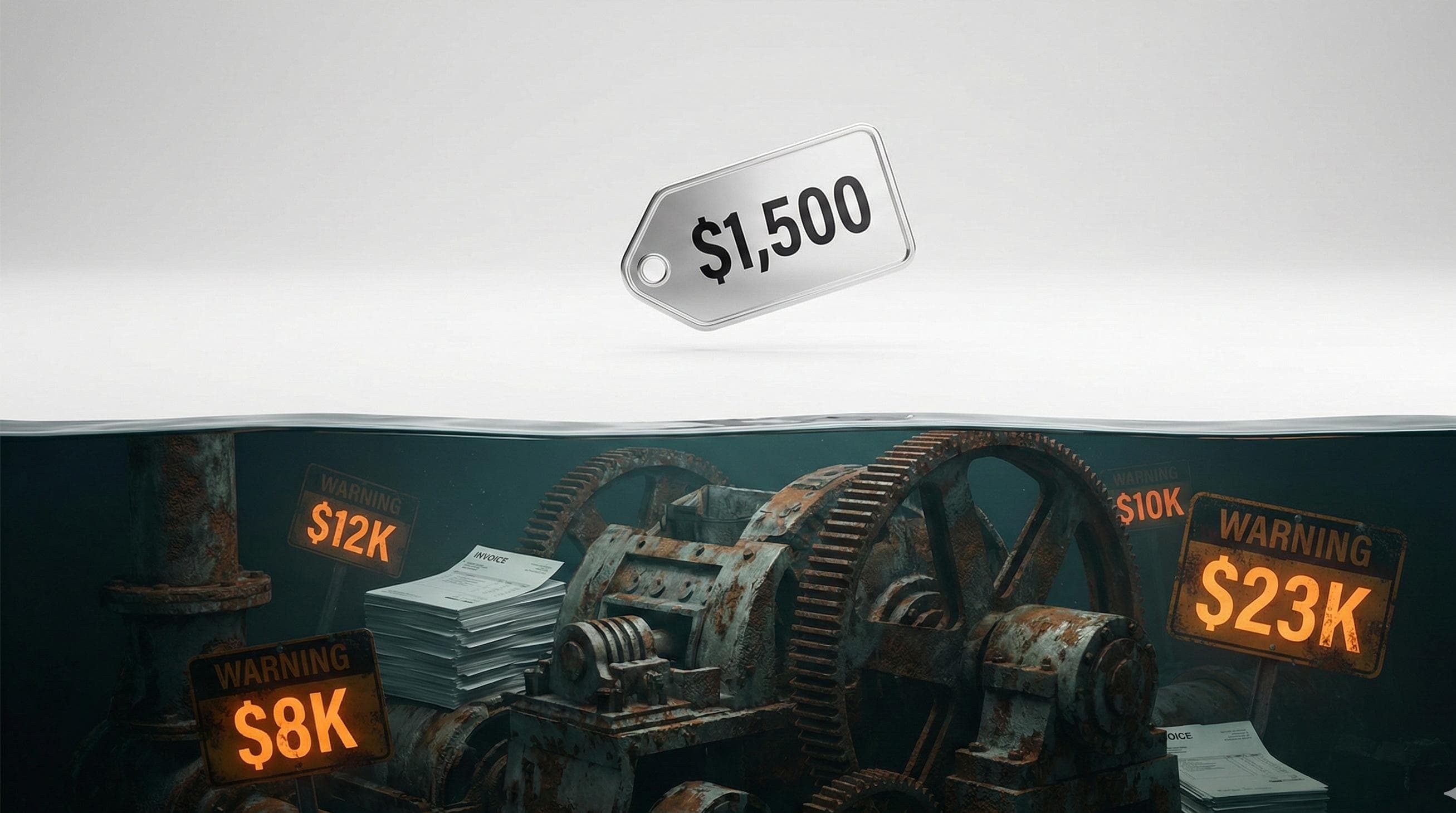
The $1,500 Automation That Cost $12,000
Last month, a client showed me their invoices. $1,500 for automation in January. $5,300 for emergency fixes in June. Another $4,200 in October. I did the math: $10,500 in ten months for what they were told would be a "one-time investment."
The system worked beautifully for four months. Lead capture flowing into HubSpot, automated follow-ups via Zapier, scheduling through Calendly - all running smoothly.
Then Calendly permanently deprecated their V1 API in August 2025 after announcing the phase-out in May 2025.
Overnight, three critical workflows stopped working. The original consultant? Booked solid with other projects. Two-week wait minimum. Meanwhile, leads were piling up unprocessed and the sales team was back to manual data entry.
Emergency consultant time. Here's what it actually cost:
- Emergency diagnosis: $800
- Re-learning their system: $2,400 (16 hours at $150/hour)
- API fix and testing: $1,200
- Additional issues discovered during fix: $900
- Total emergency fix: $5,300
That $1,500 automation now cost $6,800 total. And it happened again six months later when Stripe released their Acacia version with breaking changes to webhook handling as part of their new twice-yearly major release cycle. By year two, they'd spent over $12,000 - enough to cover 40 months of $300/month proactive maintenance.
I've had this conversation 20+ times. The details change - different consultants, different APIs, different breaking points - but the math is always the same.
If you're researching the real cost of cheap automation, buckle up. The numbers aren't pretty.
Cheap automation costs more. Not sometimes - always.
Here's why.
Why We Only See Upfront Costs
When evaluating automation quotes, most businesses make the same mistake: they compare upfront costs. $1,500 versus $5,000? Easy choice, right?
Here's the psychological trap: We compare what's easy to compare. $1,500 versus $5,000? The spreadsheet says $1,500 wins. Done.
Except that spreadsheet is lying to you. Or rather, it's only showing you 20% of the truth.
The upfront cost is concrete, easy to compare, and fits neatly into budget approval processes. Consulting proposals emphasize the one-time fee. "Maintenance" gets mentioned as an optional add-on, making it sound skippable.
But here's what doesn't show up in those initial quotes when calculating total cost of ownership:
Future consultant fees when someone new has to learn your system from scratch. Emergency rates when things break at the worst possible moment. Lost revenue during the days your automation sits broken. Opportunity cost of having team members manage multiple consultants instead of growing the business.
The industry isn't just hiding this - the entire build-and-bail model depends on you not doing this math. If prospects calculated true costs, cheap agencies would go out of business.
It's like buying the cheapest used car without calculating insurance, repairs, higher gas costs, and time at the mechanic. The sticker price is just the beginning.
The Hidden Costs of Cheap Automation: What They Don't Tell You
Here are the hidden costs that turn $1,500 automation into $12,000+ over 18-24 months:
Cost #1: The Re-Learning Tax
Every new consultant bills you to learn your existing system. This is pure waste.
The math:
- Average system understanding time: 12-16 hours
- Typical consultant rate: $100-200/hour
- Re-learning cost per consultant: $1,200-3,200
- Multiply by 3-4 consultants over two years
- Total: $3,600-$12,800 in re-learning alone
One real estate agency had three different consultants touch their Airtable-to-Calendly booking system in 18 months. Each billed discovery time. They paid $6,800 just for people to understand what the previous consultant built. None of that money improved their system. It was pure educational overhead, repeated three times.
The waste here is staggering. You're paying for the same education repeatedly.
Cost #2: Crisis Pricing
When your system breaks at a critical moment, you pay premium rates.
The math:
- Normal consulting: $100-150/hour
- Emergency/rush rates: $200-300/hour
- Weekend/after-hours: $250-400/hour
- Priority queue fees: $500-1,000 flat fee
Real scenario: A coaching business's HubSpot integration broke during their biggest launch week. They needed an immediate fix. Final bill:
- $750 priority fee to jump the queue
- $275/hour for 14 hours of emergency work
- Total: $4,600 for what would have been a $300 proactive fix
You're not in a position to negotiate when operations are down. Consultants know this. Crisis rates reflect your desperation, not the complexity of the work.
Cost #3: Knowledge Leak Compounding
Each new consultant approaches problems differently, creating technical debt that compounds.
Consultant A builds the Zapier workflows their way. Consultant B doesn't understand A's approach and adds Make.com workarounds. Consultant C inherits a mess and recommends starting over. The rebuild costs $5,000-8,000. You've now paid for the same automation three times.
One marketing agency's lead routing system was touched by four different consultants over 18 months. Each added their own logic without documentation. By month 18, no one could understand which platform was doing what. They had to rebuild from scratch. The original $2,000 automation became $9,500 over two years.
Cost #4: System Decay
Small issues compound without proactive maintenance. What could be a 30-minute fix today becomes a 10-hour rebuild later.
Typical decay pattern:
- Month 1-3: Minor issues appear ($100-300 to fix)
- Month 4-8: Integration breaks ($800-1,500)
- Month 9-12: Major system failure ($2,000-4,000)
- Month 13+: Rebuild consideration ($5,000-10,000)
What causes decay?
The data is sobering: 14.78% of all API changes are breaking changes, according to a large-scale study of real-world libraries. And 75% of organizations update their APIs daily or weekly. That's a lot of potential breakage.
In 2024-2025 alone, we saw major changes across platforms:
Calendly: V1 API permanently deprecated August 2025 (announced May 2025). Not backward compatible with V2.
Stripe: Introduced twice-yearly major releases with breaking changes (like Acacia in September 2024), replacing their unpredictable versioning model.
HubSpot: v2 Owners API sunset March 2025. Contact Lists API (v1) deprecation extended from September 2025 to April 2026. Constantly moving timelines create planning chaos.
Airtable: December 2024 enforcement of rate limits broke automations overnight. Free plans limited to 1,000 API calls monthly, Team plans to 100,000.
And here's the kicker: API uptime declined 60% year-over-year in 2025. That translates to approximately 10 extra minutes of downtime per week across platforms.
Real example: A consulting firm ignored three API deprecation warnings because they didn't know who to ask. When Calendly shut down their V1 webhooks in August 2025, five workflows broke simultaneously. Emergency rebuild: $6,200. Proactive updates would have been $400 total.
Cost #5: Opportunity Cost
This one doesn't show up in invoices, but it's real. Revenue lost while broken automation sits unfixed adds up fast.
Example scenario:
- Broken lead qualification automation
- Leads not being routed for five days
- Average: 20 leads/day × $500 customer value × 15% close rate
- Lost revenue: $1,500/day
- Five-day delay: $7,500 in lost opportunity
Harder to track but equally real: customer frustration from broken Calendly booking links, team time spent on manual workarounds, reputation damage from broken chatbot responses, delayed launches while waiting for consultant availability.
Your business bleeds while waiting for that cheap consultant to become available.
The True Cost Comparison
Let's calculate the total cost of ownership everyone avoids:
| Cost Category | "Cheap" Automation | Maintenance Model |
|---|---|---|
| Initial Implementation | $1,500 | $3,500 |
| Re-learning Tax | $6,800 (3 consultants) | $0 (same team) |
| Crisis Pricing | $4,600 (2 emergencies) | $0 (proactive fixes) |
| System Decay | $3,200 (compounding issues) | $0 (caught early) |
| Opportunity Cost | $7,500 (5 days downtime) | $0 (minimal downtime) |
| Monthly Maintenance | $0 | $5,400 ($300 × 18) |
| Total 18-Month Cost | $23,600 | $8,900 |
The "cheap" option costs 2.5x more.
And this is conservative. We've seen 4x, even 5x. But 2.5x is common enough that if you're not calculating TCO, you're probably overpaying by this much right now.
The Five Questions to Ask Any Automation Consultant
Before signing with anyone, ask these questions:
1. "What happens when this breaks in six months?"
Good answer: "We maintain it proactively. It's included in our model."
Red flag: "You can call us if issues come up." (Translation: pay crisis rates later)
Ask us this question. Our answer: "It won't break because we monitor it proactively, but when something does need updating - and something will - that's included in your $300-800/month maintenance. You'll never see a surprise invoice for 'routine fixes.'"
2. "How many clients from 18 months ago do you still actively maintain?"
Good answer: Specific number with references available.
Red flag: "Most clients can handle it themselves after we hand it off." (They're gone)
3. "What's included in ongoing maintenance versus additional fees?"
Good answer: Clear breakdown of proactive monitoring, updates, bug fixes included.
Red flag: "Maintenance is optional" or vague "support packages available."
4. "What happens when Calendly updates their API or Stripe changes their webhooks?"
Good answer: "We monitor for changes and update your system proactively."
Red flag: "You'll need to contact us" or "That would be a separate project."
5. "Can I talk to a client you built for 12+ months ago?"
Good answer: "Absolutely, here are three references."
Red flag: Hesitation, excuses, or only recent client references.
If you get more red flags than good answers, walk away. You're looking at a build-and-bail consultant who'll leave you stranded.
The Go Rogue Ops Difference: Why We Changed Our Model
For three years, we ran like every other agency. Built a system, handed over the login credentials, sent a "congratulations" email, and moved on to the next project. Our proposal software had a template for it. Our calendar was packed. We were busy.
And our clients' automation was dying.
I got a call from a client I'd worked with 8 months earlier. Their lead capture system was broken. They were panicking. They needed help immediately.
I was booked solid for three weeks.
That moment broke something in me. We'd built them a good system. It worked great when we handed it off. But Zapier updated their webhook handling, their business evolved, and nobody was watching. The automation suffocated from neglect while we chased new projects.
That wasn't automation. That was abandonment with a login sheet.
We realized we were optimizing for our short-term revenue, not client long-term success. That had to change.
Now we require ongoing maintenance for all done-for-you projects. Not as an upsell or profit grab - as the only honest way to do automation.
Our hybrid model:
Path 1: Done-For-You + Maintenance (required)
- We build your automation
- We maintain it ongoing ($300-800/month)
- You focus on your business, we handle the tech
- Investment: $3K-15K one-time + monthly maintenance
Path 2: Done-With-You + Optional Advisory
- We build while training your team
- You learn to maintain it yourself
- Optional ongoing advisory available
- Investment: $5K-12K one-time + $500-1,500/month (optional)
Path 3: Pure Maintenance
- For existing automation (built by us or others)
- We audit, adopt, and maintain ongoing
- Investment: $300-800/month
Why this works:
For you: Predictable monthly cost, priority support, proactive monitoring, no re-learning tax, lower total cost over 18-24 months.
For us: Recurring revenue creates a sustainable business, long-term relationships instead of transactional projects, incentive to build quality systems because we maintain them, ability to invest in our team instead of constantly hunting for new projects.
The realization:
Under our old model, we built 40 projects and actively maintained three. Clients called with broken systems and we were always "too busy." They paid three times more to emergency consultants while we chased new projects.
Under our new model, we build 15 projects and maintain all 15. Every client has working systems 18 months later. We catch issues before they break. Clients pay less total while we get recurring revenue.
Everyone wins.
Is this model harder to sell? Yes. Do some prospects walk when they hear "maintenance required"? Absolutely. We lose 40-50% of leads who just want cheap automation.
Good.
Those aren't our clients. They're future emergency calls we don't want to get.
We don't build and bail anymore because we've seen the damage it causes.
What to Do Now
If You're Evaluating Automation Quotes:
Calculate 2-year total cost of ownership, not just upfront cost. Pull out the quotes you're evaluating. Open a spreadsheet. Plug in the formula from above. Add $3,600 for re-learning, $4,600 for two emergencies, $3,200 for system decay. Now compare the totals.
Ask the five questions listed earlier. Call the consultant back. Ask question #5: "Can I talk to a client from 12+ months ago?" If they hesitate, you have your answer.
Request maintenance plans upfront. If maintenance is an "optional add-on," it's not real maintenance. It should be required, not an upsell.
Check longevity references. Ask for clients they've maintained for 12+ months. If they can't provide any, they're build-and-bail.
Fix processes first, then automate. If your current workflow is chaotic, automation will just make chaos faster. Any consultant who doesn't ask about your processes before quoting is waving a red flag.
If You Already Have "Cheap" Automation:
Audit your system health. When was it last updated? Are there pending API deprecations? Who would you call if it breaks tomorrow?
Calculate your actual costs. How much have you spent on fixes? How many different consultants have you hired? What's your re-learning tax so far?
Consider adoption. It can be cheaper to adopt and maintain an existing system than rebuild. See our Path 3: Pure Maintenance model.
The Bottom Line
Cheap automation costs more. Not sometimes - always. The question isn't if hidden costs will emerge, but when.
This is why cheap automation fails. The promise is seductive. The math doesn't lie.
You're not choosing between $1,500 and $3,000.
You're choosing between:
- $23,600 over two years (cheap upfront + hidden costs)
- $8,900 over two years (honest pricing + maintenance included)
The math is clear. The choice is yours.
Ready for Honest Pricing?
We show you the full cost upfront - implementation plus maintenance. No surprises, no hidden fees.
Our minimum investment: $3K implementation + $300-800/month maintenance.
If that's too expensive, automation probably isn't right for your business yet. And we'd rather tell you that honestly than take your money and leave you with a system that'll break.
But if you value reliability over cheap, we should talk.
Book Your Free Discovery Call →
Already have automation that needs care? Learn about our Pure Maintenance path →
Not ready for automation yet? Download our Automation Readiness Checklist → to evaluate if your business is ready.
Share this article
Ready for automation that lasts?
Book your free 45-minute discovery call. We'll discuss your operations, identify waste using lean principles, and recommend which path (if any) makes sense for you.
Book Your Free Discovery Call