Lean Methodology for Small Businesses
Written by
Go Rogue Ops Team
You Don't Need to Be Toyota to Benefit from Lean
When most people hear "Lean Methodology," they think of massive Toyota factories, six-sigma black belts, and complex industrial engineering. They think it's something for big corporations with thousands of employees and multi-million dollar consultant budgets.
They're wrong.
In fact, Lean is arguably MORE powerful for small businesses (10-50 employees) than it is for the giants. Why? Because in a small business, waste isn't just a rounding error on a balance sheet—it's the difference between scaling and stagnating. It's the difference between a team that's energized and a team that's burning out.
Lean is simply a way of thinking: identifying what creates value for your customer and systematically eliminating everything else. Here's how to apply practical Lean thinking to your small business operations.
The "Small Business Waste" Problem
In a large corporation, waste is often hidden in layers of bureaucracy. In a small business, waste is visceral. It looks like:
- The owner spending 3 hours on Sunday night fixing invoices because the process is broken.
- The sales team chasing 50 "junk" leads because nobody defined what a qualified lead actually looks like.
- A project being delayed for a week because it's sitting in an "approval" inbox that nobody checks.
- Two people accidentally doing the same task because there's no clear handoff.
This is "operational friction," and it's the #1 killer of small business growth. You try to scale, but the friction increases until the whole machine grinds to a halt. You hire more people to handle the friction, which creates more complexity, which creates more friction. It's a death spiral.
Lean is the antidote.
The 5 Principles of Practical Lean
For a small business, you can strip away the academic jargon and focus on these five core principles:
Principle 1: Define Value (From the Customer's Perspective)
The only thing that matters is what your customer is willing to pay for. Everything else is waste. Most small businesses are doing "ghost work"—tasks that feel important but don't actually move the needle for the customer.
Action: Look at your core service. Ask: "If we stopped doing [Task X], would the customer notice? Would they care?" If the answer is no, you've found waste.
Principle 2: Map the Value Stream
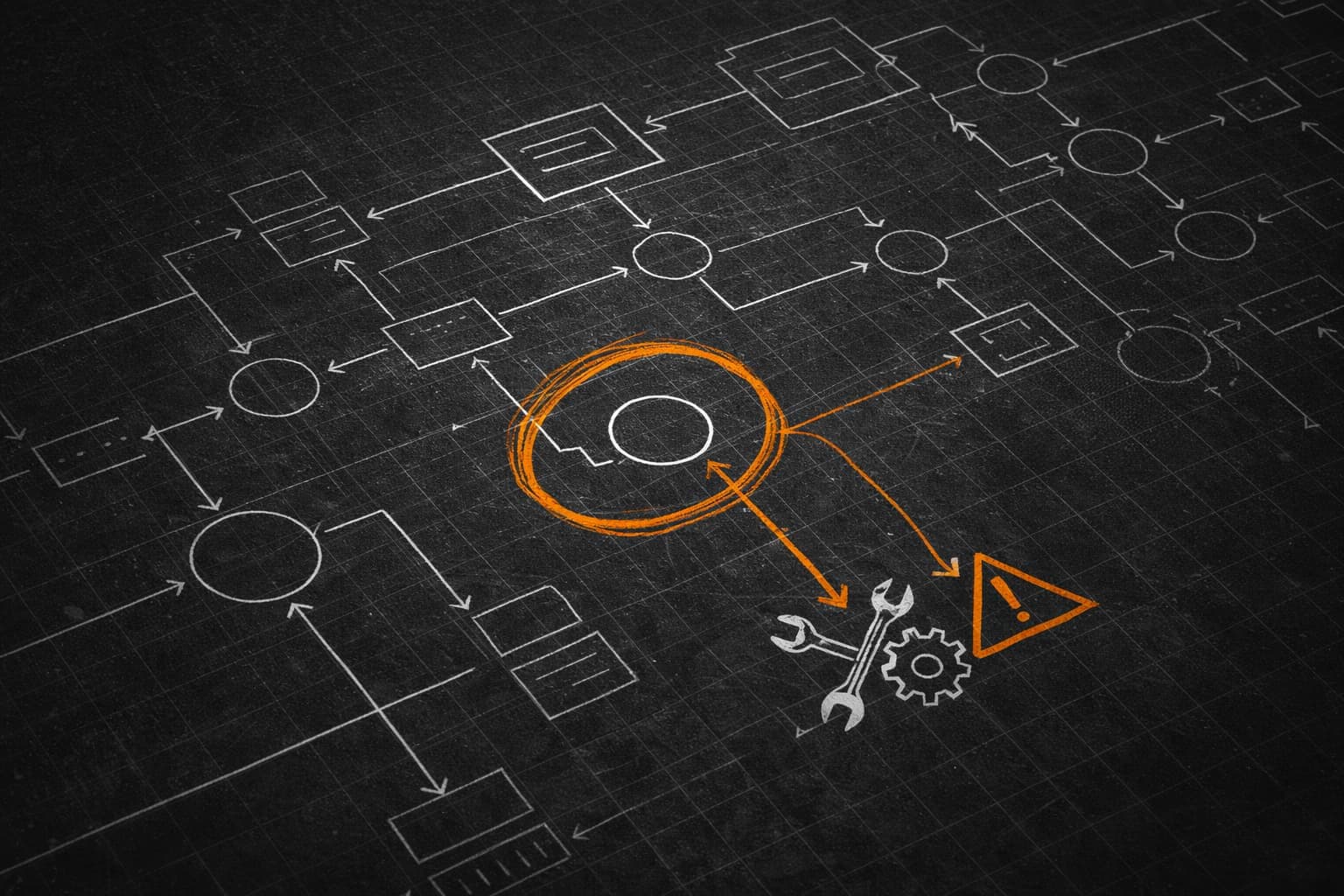
This is just a fancy way of saying "document the journey from lead to cash." Map out every step. Don't document how it should work—document how it actually works, warts and all.
Action: Get your team in a room (or a Zoom/Miro board). Map one process from start to finish. You'll be shocked at the "hidden" steps Karen and Dave do every day that nobody else knew about.
Principle 3: Create Flow
Waste happens at the handoffs. When a task stops moving and sits in an inbox, that's waste. Your goal is to make work flow through your business without stopping. No "piling up," no "waiting for approval," no "I forgot where this was."
Action: Identify where work sits idle. Is it waiting for an approval? Waiting for information? Waiting for a manual trigger? These are your first targets for elimination or automation.
Principle 4: Establish Pull
Don't do work until it's needed. Most businesses "push" work onto the next stage before it's ready, leading to backlogs and confusion. "Pull" means work is only triggered by actual demand.
Action: Stop doing work "just in case." Only start the next stage of a project when the previous stage is fully complete and the next person is ready to receive it.
Principle 5: Pursue Perfection (Kaizen)
Lean isn't a one-time project; it's a culture of "continuous improvement" (Kaizen). It's the belief that no process is ever "finished." Small, 1% improvements every week compound into massive efficiency gains over a year.
Action: Set aside 30 minutes every Friday with your team to ask: "What was the most frustrating part of this week? How do we fix the process so it doesn't happen next week?"
The 8 Types of Waste in Small Business
To fix waste, you have to see it. In Lean, we look for these eight types of waste (often remembered by the acronym DOWNTIME):
- Defects: Rework, errors, missing info. (The email asking "Hey, did you forget the attachment?")
- Overproduction: Doing more than is needed. (The 15-page report when the client only needs the summary.)
- Waiting: Idle time. (Waiting for the owner to sign off on a $50 expense.)
- Non-Utilized Talent: Smart people doing dumb work. (Your $100/hr consultant doing data entry.)
- Transportation: Moving info between systems. (Copy-pasting leads from email to CRM.)
- Inventory: Work-in-progress piling up. (50 half-finished projects.)
- Motion: Unnecessary clicks or context switching. (Toggling between 7 tabs to complete one task.)
- Extra-Processing: Doing work that doesn't add value. (Double-checking someone else's perfect work.)
Exercise: Pick one of these today. Tell your team: "This week, we're on a hunt for [Waiting] waste. Whenever you're waiting for something to happen, write it down." You'll be amazed at what you find.
Why Lean Comes BEFORE Automation
This is the Go Rogue Ops mantra: Fix the process first, then automate.
The biggest mistake small businesses make is thinking automation will fix a broken process. It won't. If you automate a mess, you just get a faster, more expensive mess. You lock in the waste.
If you have a manual process with a 10% error rate, and you automate it, you now have an automated process generating errors at scale. And now those errors are harder to find and fix.
The Lean sequence: 1. Map it. 2. Eliminate the waste (don't automate it!). 3. Simplify what's left. 4. THEN automate.
The "Lean Audit" for Small Teams
You don't need a consultant to start. Do this with your team this Friday:
- Pick one process: Keep it small (e.g., "how we handle a new lead" or "how we invoice").
- Map it: Every step. Every email. Every click.
- Label it: - Green = Value (Customer pays for this) - Yellow = Necessary Waste (Compliance, taxes, admin) - Red = Pure Waste (Rework, waiting, overprocessing)
- Eliminate the Red: Just stop doing it. See what happens. (Spoiler: Usually nothing breaks, and everyone is happier.)
- Simplify the Yellow: Can we do this in half the steps?
Case Study: The $0 Efficiency Gain
We worked with a marketing agency where the account managers spent 5 hours a week creating "status update" reports for clients. They wanted us to automate the report generation.
We did a Lean audit first. We asked the clients: "How much of this report do you actually read?"
The answer: "We just look at the 'Total Spend' and 'Leads Generated' numbers at the top. We never open the attachments."
We didn't build an automation. We just changed the process: a 3-sentence email with the two numbers. The "automation" was simply deleting a useless task.
Result: 5 hours/week saved per manager. $0 spent on software. That's Lean.
Conclusion: Start Small, Think Lean
Lean isn't about working harder. It's about removing the obstacles that prevent you from doing your best work. It's about respecting your team's time by not making them do work that doesn't matter.
Small businesses that embrace Lean thinking are the ones that scale without chaos. They're the ones that maintain high margins while their competitors are drowning in complexity.
Ready to find the waste in your business?
Start with a Free 45-Minute Lean Audit. We won't try to sell you automation you don't need. We'll help you map your process, find the red flags, and show you exactly where you're leaking time and money.
[Book Your Free Lean Audit →](/contact)
Because question everything means starting with the question: "Why are we doing this in the first place?"
Share this article
Ready for automation that lasts?
Book your free 45-minute discovery call. We'll discuss your operations, identify waste using lean principles, and recommend which path (if any) makes sense for you.
Book Your Free Discovery Call